TikTok Nostalgia

I used TikTok on a daily basis from 2019 to 2023. I can’t begin to imagine the amount of data the platform collected about me throughout that time. Like so many other platforms nowadays, the more I used it, the more personalised the recommendations felt. I recently became curious about what I would find if I reinstalled the app. Would the feedback loop, after 3 years of no direct data points, be stuck on an old version of me? Or would the platform have access to third-party data to inform my feed?
What struck me most was how ‘Spanish’ the content was. For context, I am a Spaniard raised in the USA and UK. As a result, the majority of online content I’ve engaged with has been from those countries. However, throughout 2019 to 2021, I lived in Spain, and between 2022 and 2023, I was still spending lots of time there. I wondered if TikTok was still pushing content by Spanish creators for Spanish audiences because it built my profile when I was more engaged with Spanish online culture. In contrast, Instagram, which I used until earlier this year, mostly showed UK creators in my feed.
Interestingly, this content was not any content by Spanish creators. Rather than ranging from lifestyle to comedy skits or fashion, TikTok was pushing content that was specifically about ‘Spanishness’: Spanish traditional dress, history, customs, food… This is a part of a wider online trend in Spain, associated with leftist values, celebrating national and regional traditions in response to cultural homogenisation from globalisation. Perhaps TikTok identified this trend as something that would interest me because I had engaged with leftist content in the past. Safiya Umoja Noble’s writing about algorithmic systems’ bias helps understand that TikTok was selecting particular representations of Spanish culture; specifically, ones that reflect and potentially reinforce certain beliefs.
Captions
Left to right: A comedic video by popular podcaster Carlos Peguer captioned “Trying non-speciality coffee for the first time in years”; An educational video explaining the origins and meaning of Soldadito Español, a military song from 1927, after it was performed by rising pop star Judeline to promote the new film La Bola Negra (2026); An interview inside Mario Vidal’s tailor shop, which specialises in historically accurate production techniques for historical Spanish menswear. “Shirtmakers in Madrid according to Mario Vidal”
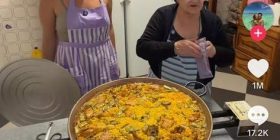
This ‘Spanish’ category overlapped frequently with another category: cooking. I used to use TikTok to find recipes. As such, it comes as no surprise that a lot of the content on my For You page was recipes. However, TikTok appeared to connect my interests in cooking and Spanish culture. It didn’t show me any international cuisine recipes the way Instagram does. Instead, the two categories reinforced each other. This was best exemplified in videos of young people cooking with their grandmothers to try not to lose family recipes. Although not overtly political, they seemed to take part in that same wider narrative against cultural homogenisation.
The third category that stood out was music and musicians. A large part of my online content consumption always revolved around upcoming musicians and songwriters performing acoustically in their bedrooms. I can even identify the first time I engaged with that kind of content on YouTube in the early 2010s. My initial interest snowballed, and the genre is still a prominent part of my feed across several platforms. However, its presence on my feed is disproportionate to its visibility elsewhere. If I had judged their popularity solely on their impact on my feed, I would have assumed they were everywhere. Similarly, until I researched the Spanish traditions trend, I thought it had a much larger presence. William Davies’ discussion of ‘clustered publics’ touches on this: the way platforms can gather people around specific interests without making it clear how large those communities actually are.
Overall, I was struck by how outdated the recommendations felt. It felt like a trip down memory lane. TikTok and its competitors keep their algorithms black boxed. We can never know exactly how they decide what to recommend. But the experience made me reflect on how the amplification of small data point shapes our interests. A passing interaction, repeated in a feedback loop, can eventually lead to certain content on our feeds. How many of my interests have I developed simply because they were repeated back to me? And what am I missing out on because it falls outside TikTok’s idea of what someone like me would enjoy?